







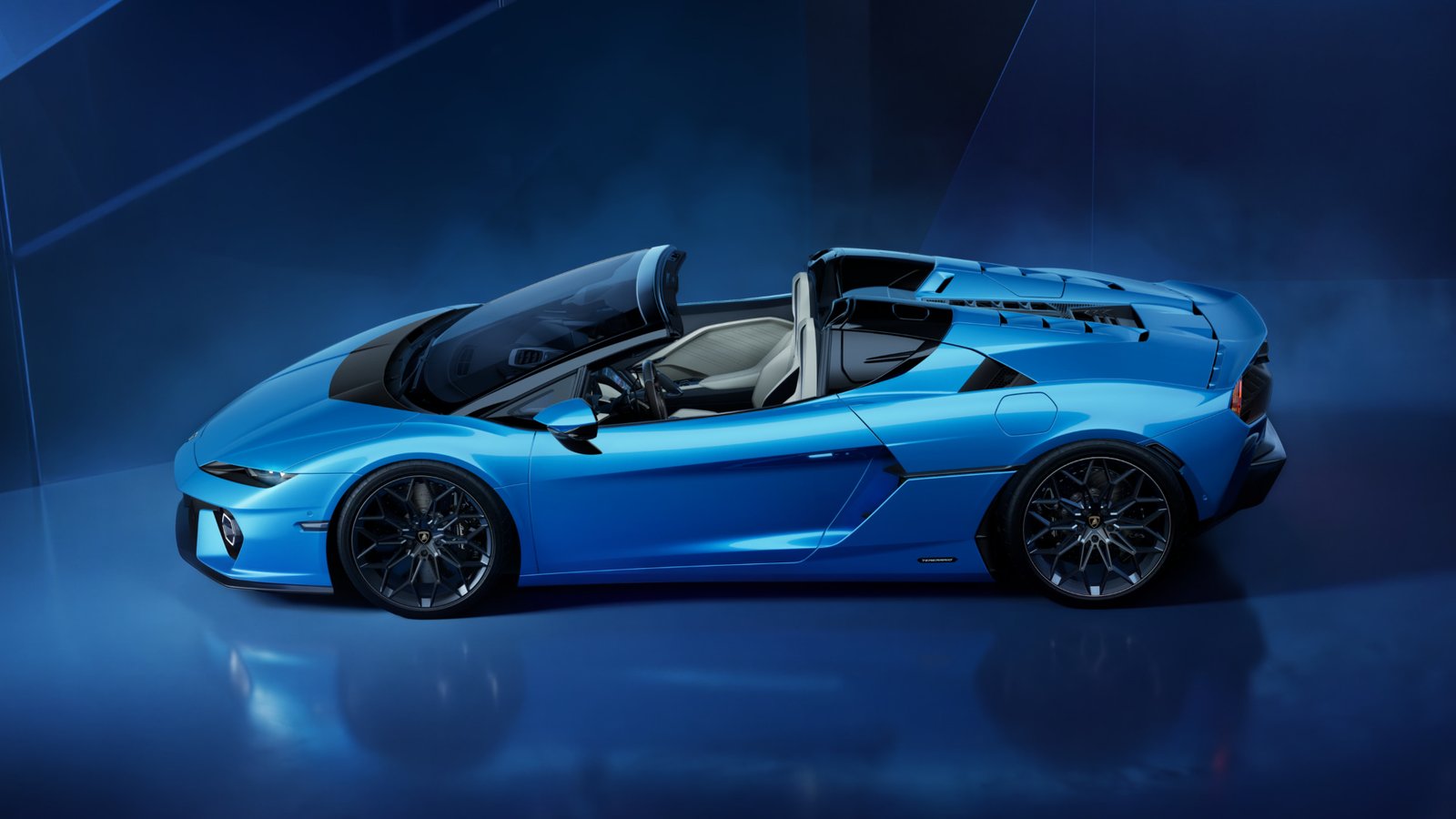


Lamborghini has built open-top cars in series for 50 years, beginning with the Silhouette in 1976 and continuing through the Jalpa, the Diablo Roadster and the Gallardo and Huracán Spyders. None of its Spyders has had a retractable hard top. The Temerario Spyder, unveiled on 19 November in Sant’Agata Bolognese and on the Dolby Family Terrace of the Academy Museum of Motion Pictures in Los Angeles, is the first. Everything else about it follows from that roof.
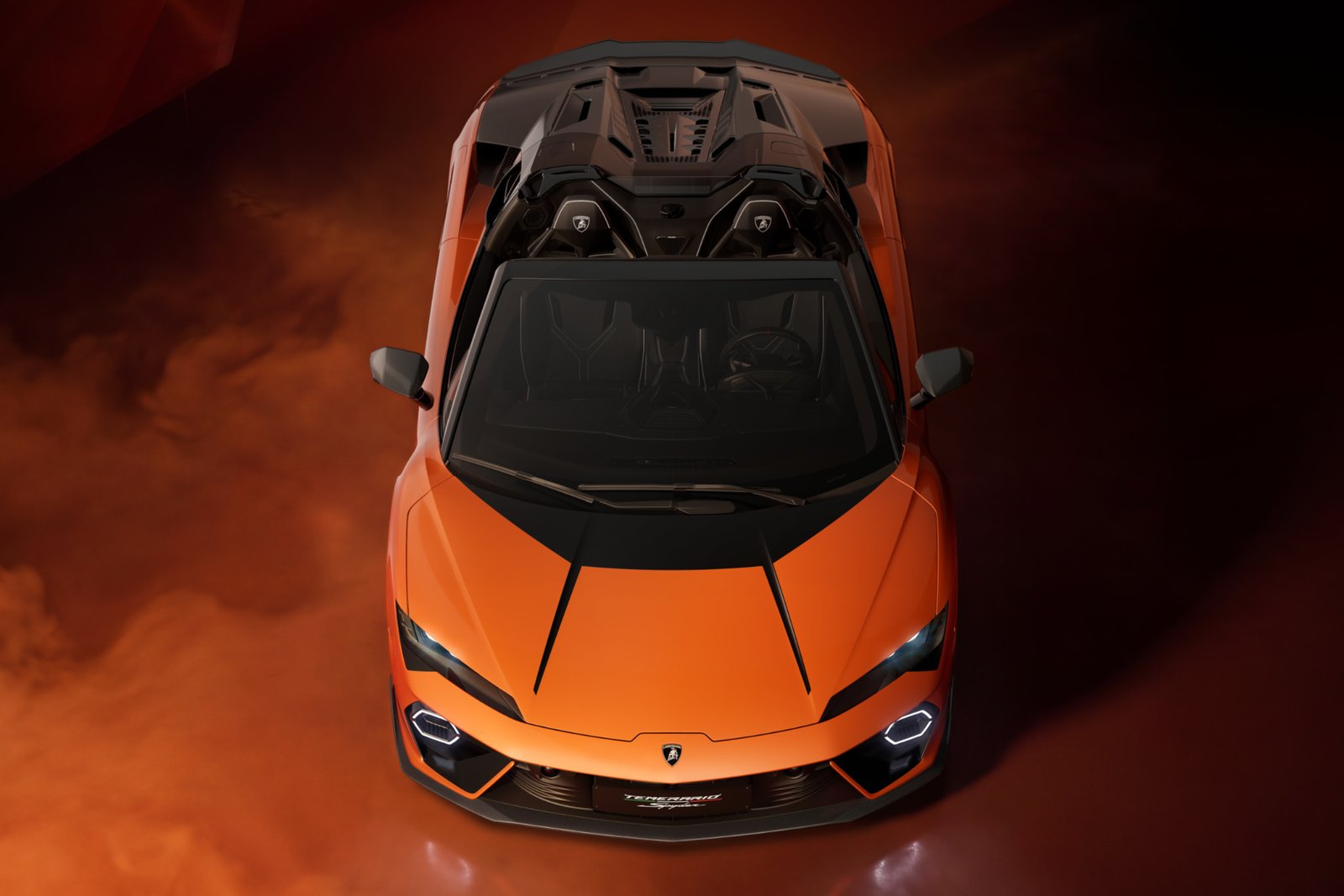
The nose carries the hexagonal and Y-shaped motifs Centro Stile Lamborghini uses across the range. Computer-generated image: Automobili Lamborghini.
The roof is fully electric, moved by ten actuators rather than the usual electro-hydraulic circuitry, and stows vertically behind the seats in a patented position. Lowered, it drops the centre of gravity by 3 mm and leaves the weight distribution unchanged. “The most stimulating challenge was integrating a complex system such as the retractable hard top without turning it into an add-on,” says Mitja Borkert, Lamborghini’s design director. Two hexagonal cowls behind the seats carry the cabin’s line through to the tail.
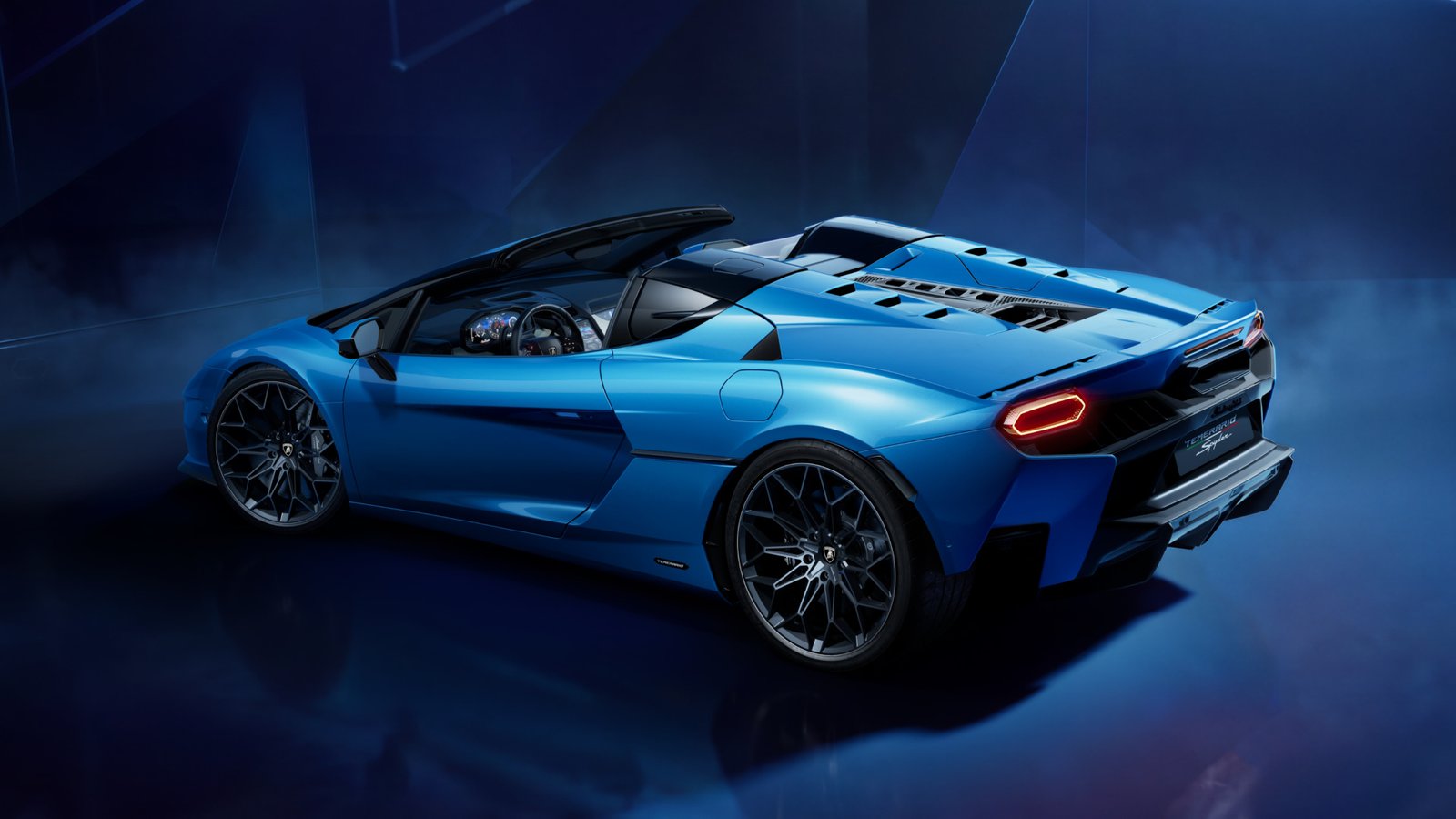
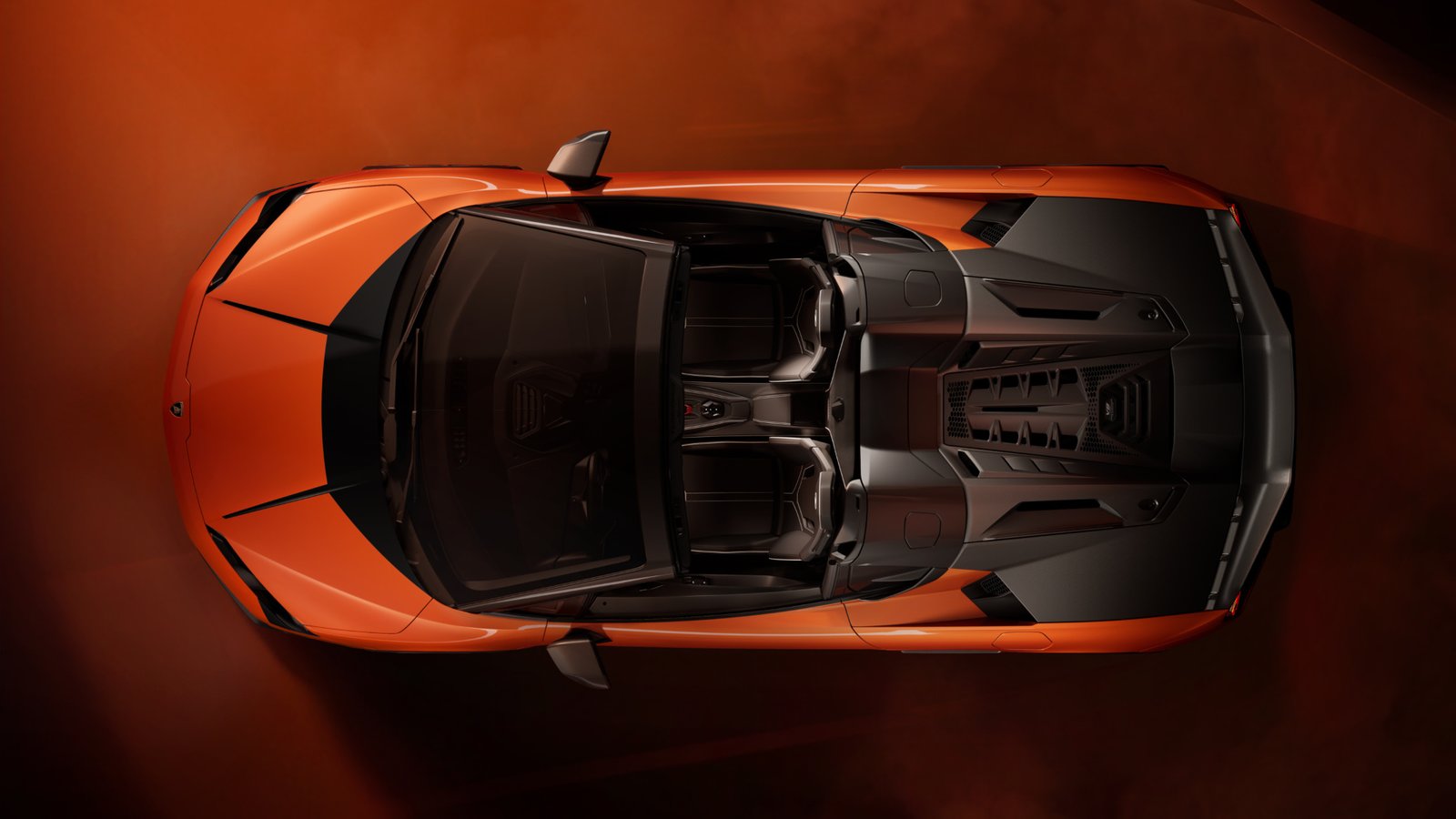
The two hexagonal cowls, from behind and from above, run the cabin into the tail and leave the engine cover on show. Computer-generated images: Automobili Lamborghini.
Underneath is the coupé’s hybrid drivetrain, at full strength. A 4.0-litre twin-turbo V8 with a flat-plane crankshaft works with three axial-flux electric motors, one at the rear and two on the front axle, for 920 CV and 800 Nm. The V8 alone makes 800 CV and revs to 10,000 rpm, which Lamborghini says is the highest engine speed of any series-production open-top super sports car with a turbocharged engine. It reaches 100 km/h in 2.8 seconds and 343 km/h flat out.
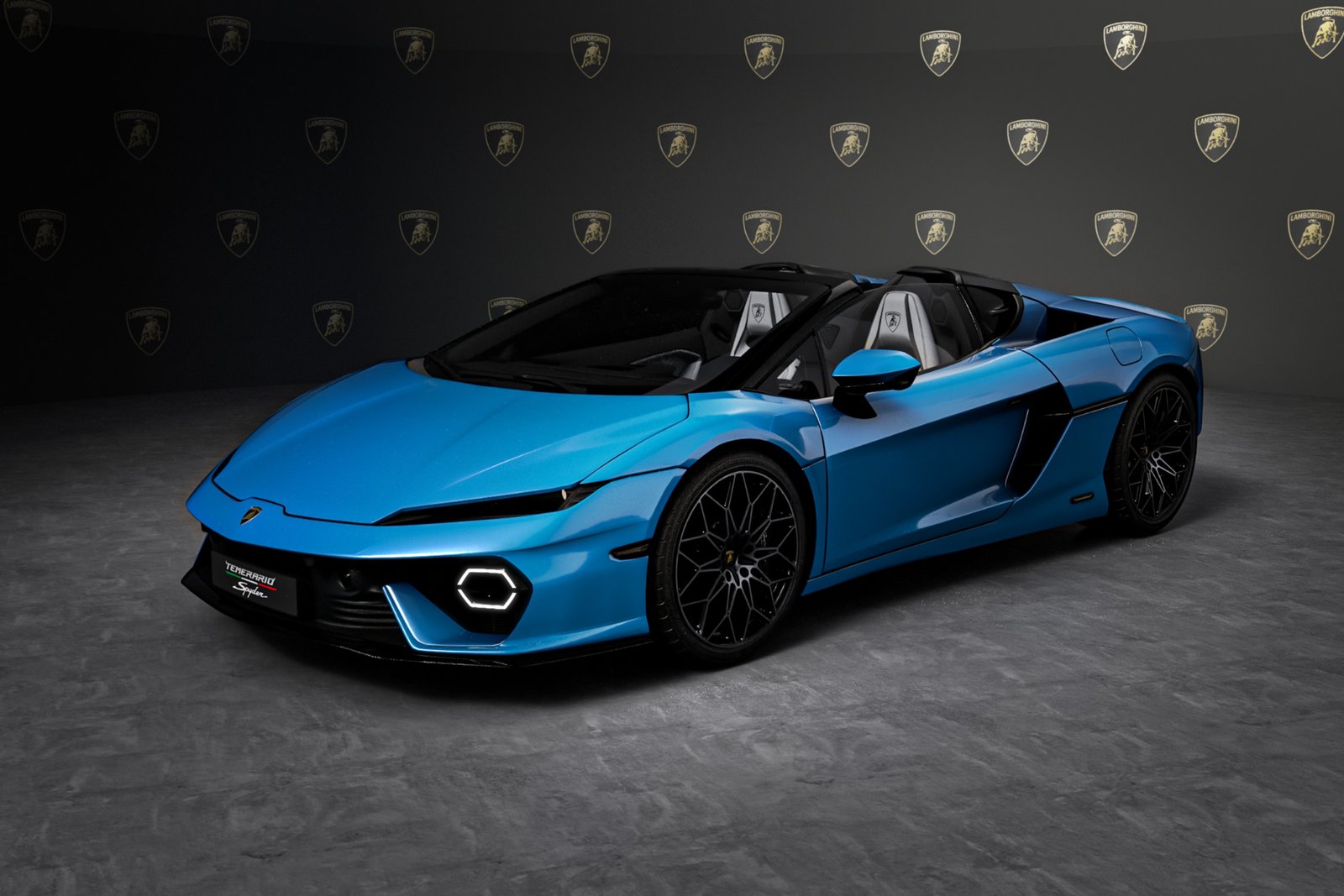
From the image set Lamborghini released on 20 November, when it added the Spyder to its Apple Vision Pro app. Computer-generated image: Automobili Lamborghini.
The structure is all-aluminium, and stiffer than its predecessor: 6 per cent more static torsional rigidity than the Huracán Spyder, with half the structural components and 80 per cent fewer heat-input welds than the Huracán EVO Spyder. In Città mode it can run on electric power alone, at up to 190 CV. That suits the city that hosted the debut. Southern California, says Stephan Winkelmann, Lamborghini’s chairman and chief executive, is “one of our leading markets for open-top super sports cars”.
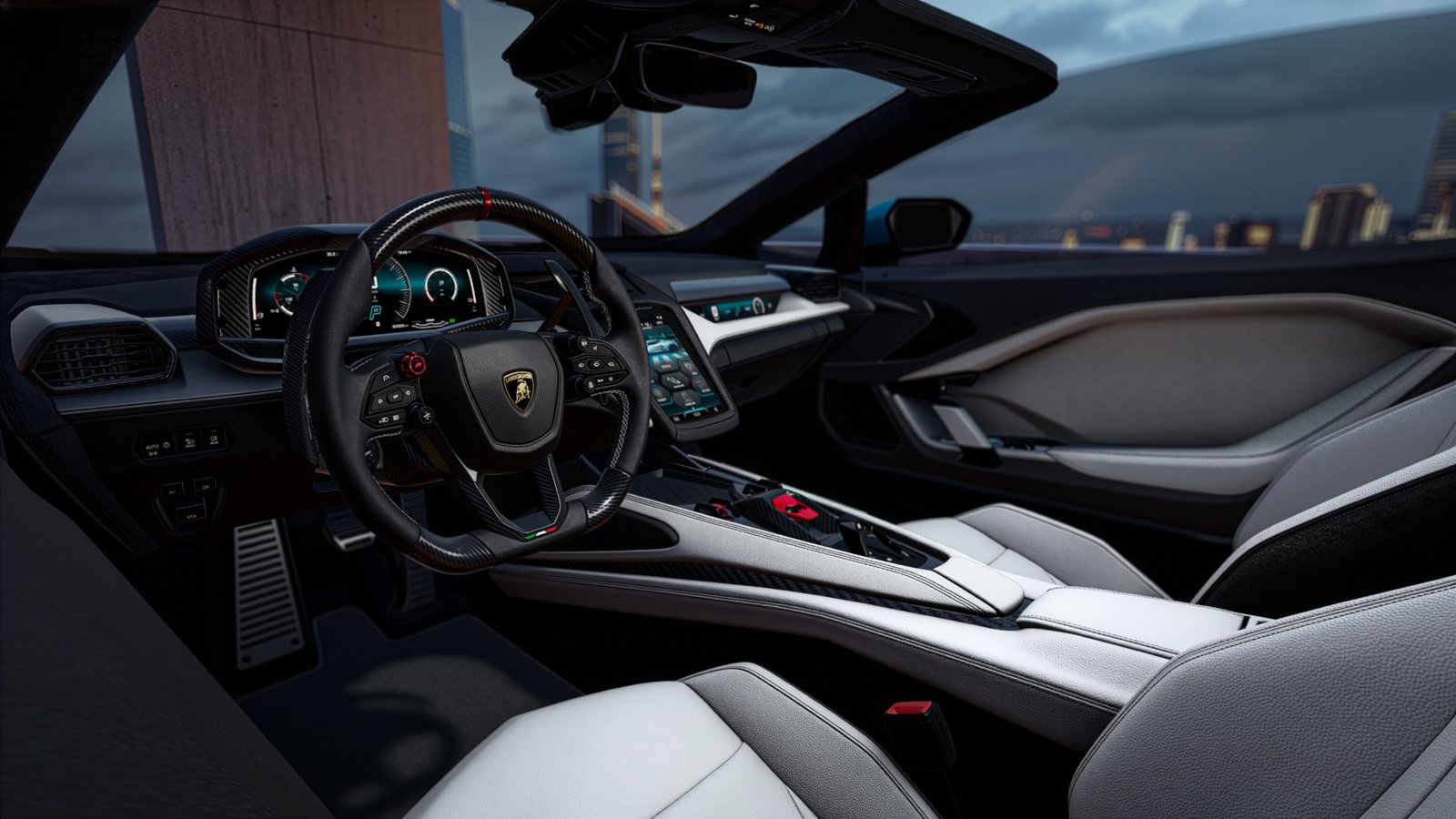
Lamborghini added the Spyder to its Apple Vision Pro app the day after the debut, so the cabin can be inspected at high fidelity. Computer-generated image: Automobili Lamborghini.
The cabin is larger than the Huracán EVO Spyder’s by 46 mm of legroom and 22 mm of headroom, enough, Lamborghini says, for occupants up to two metres tall. A three-level neck warmer is built into the seats, and the electronically adjustable rear window lets driver and passenger decide how much air, and how much V8, comes into the cockpit. The 112-litre luggage compartment in the nose is sized for a weekend rather than a fortnight.
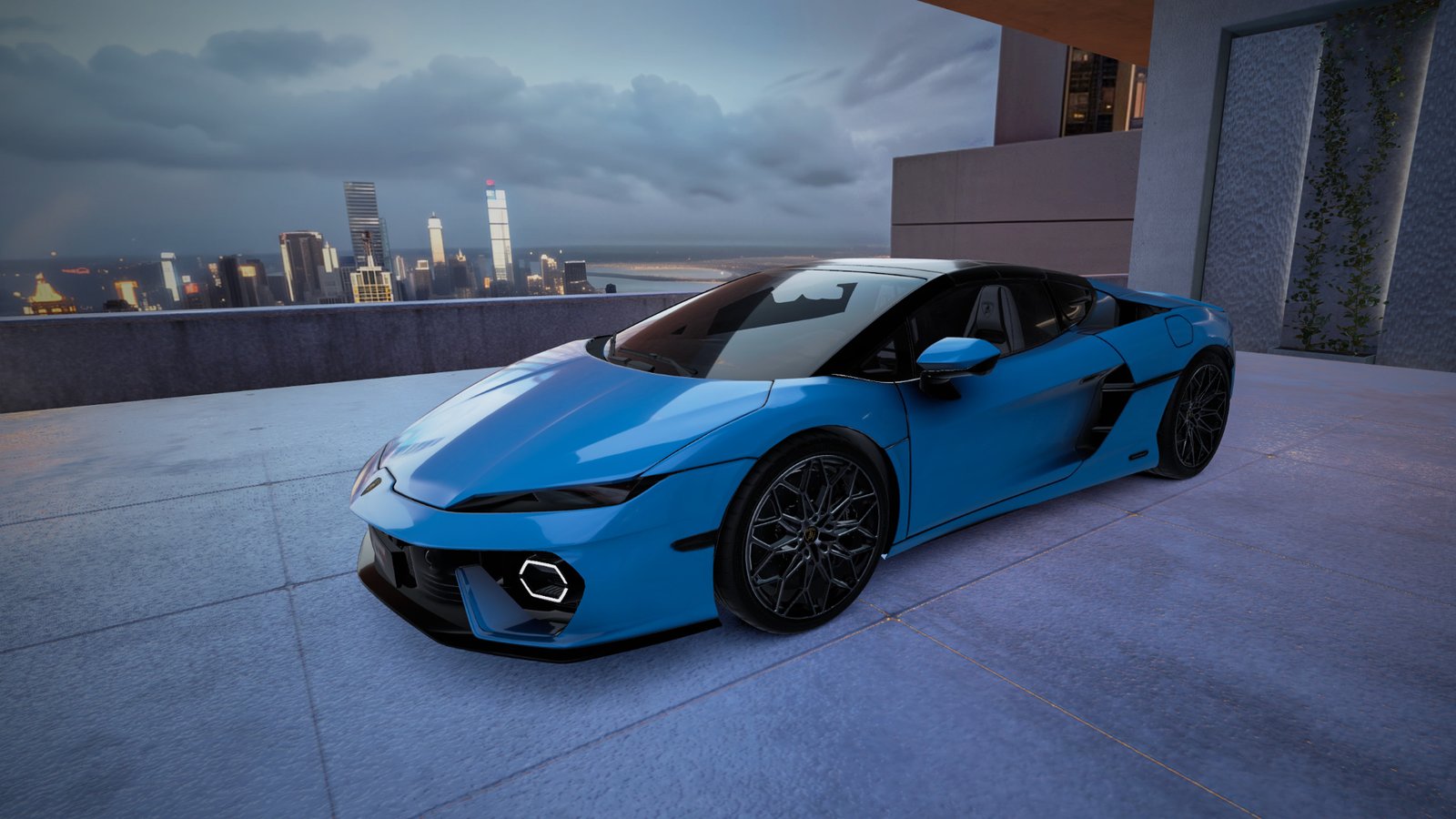
Roof raised, against a virtual skyline from the Vision Pro release. The rear window behind the seats is electronically adjustable, for air and for engine sound. Computer-generated image: Automobili Lamborghini.
Roof up, it is meant to be a different car. “We offer customers two different experiences of the same car,” says Winkelmann, “with no compromise in emotion, technology or driving pleasure.” Thirteen driving experiences combine the Città, Strada, Sport, Corsa and Corsa ESC Off modes with Recharge, Hybrid and Performance strategies, and a three-level Drift Mode manages oversteer for those who want it. Stopping is handled by CCB Plus carbon-ceramic brakes, with ten-piston calipers at the front.
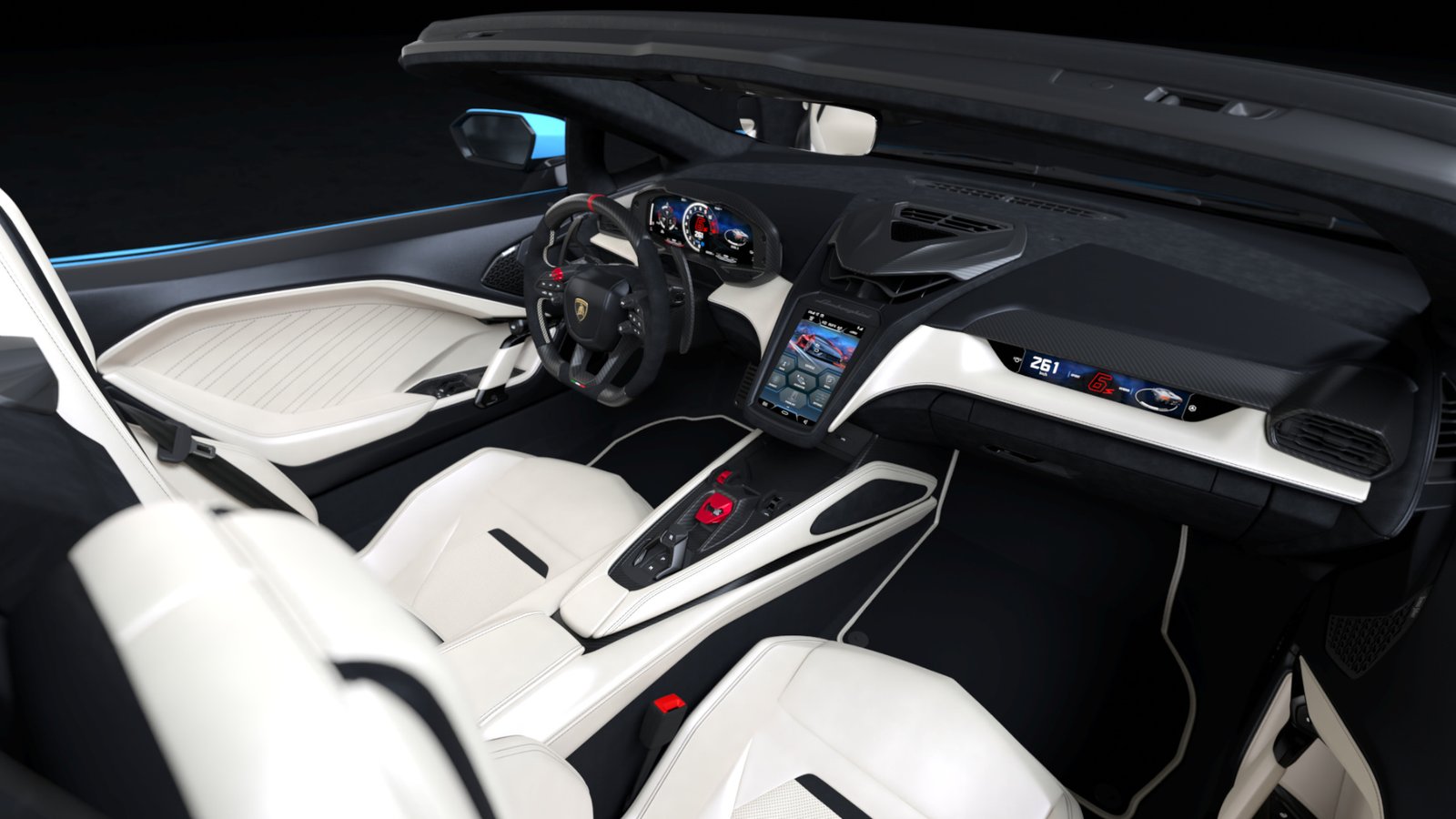
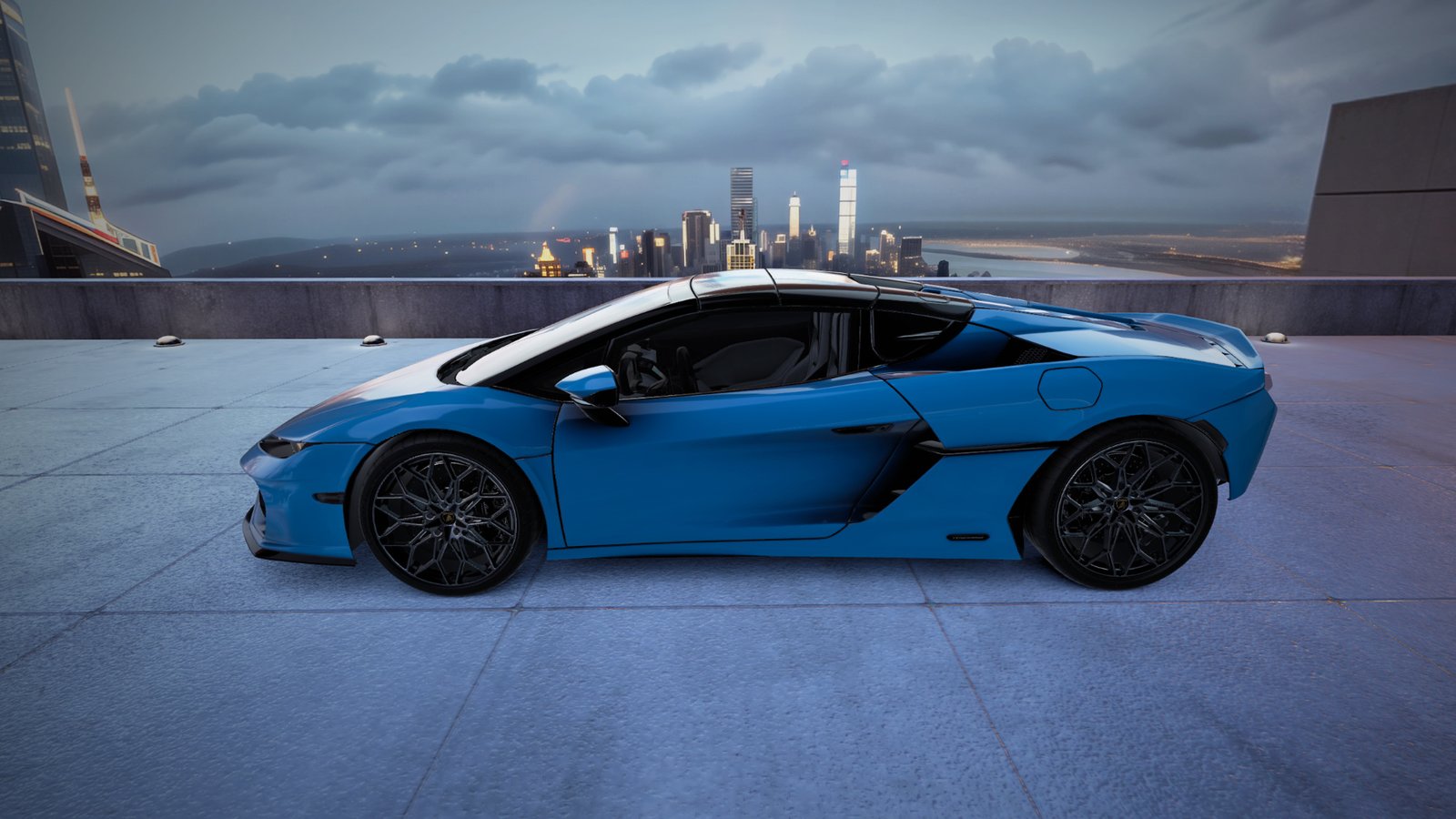
From above, a cabin with 46 mm more legroom than the Huracán EVO Spyder; in profile, the roof closed. Computer-generated images: Automobili Lamborghini.
Ad Personam offers around 400 exterior shades, harlequin finishes such as Blu Hal, Verde Agave, Oro Alba and Celeste Kami, Italian Tricolore liveries, coloured Start & Stop flaps and personalised carbon-fibre plaques. A 750 W, seven-speaker Sonus faber system is optional. So is a titanium exhaust by Akrapovič, 11.40 kg and 12 per cent lighter than the standard system, introduced on the Temerario Coupé on 11 November, eight days before the Spyder.
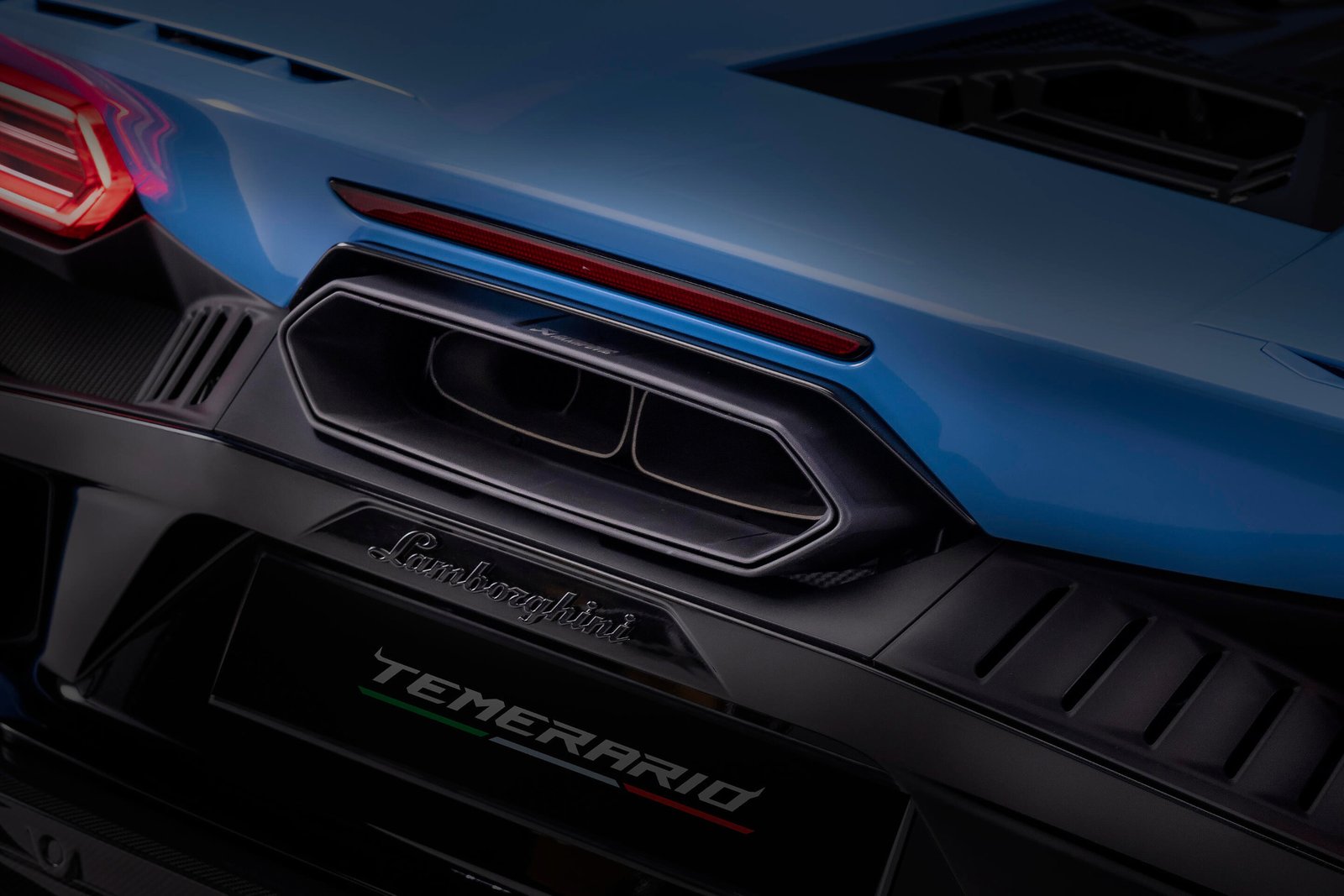
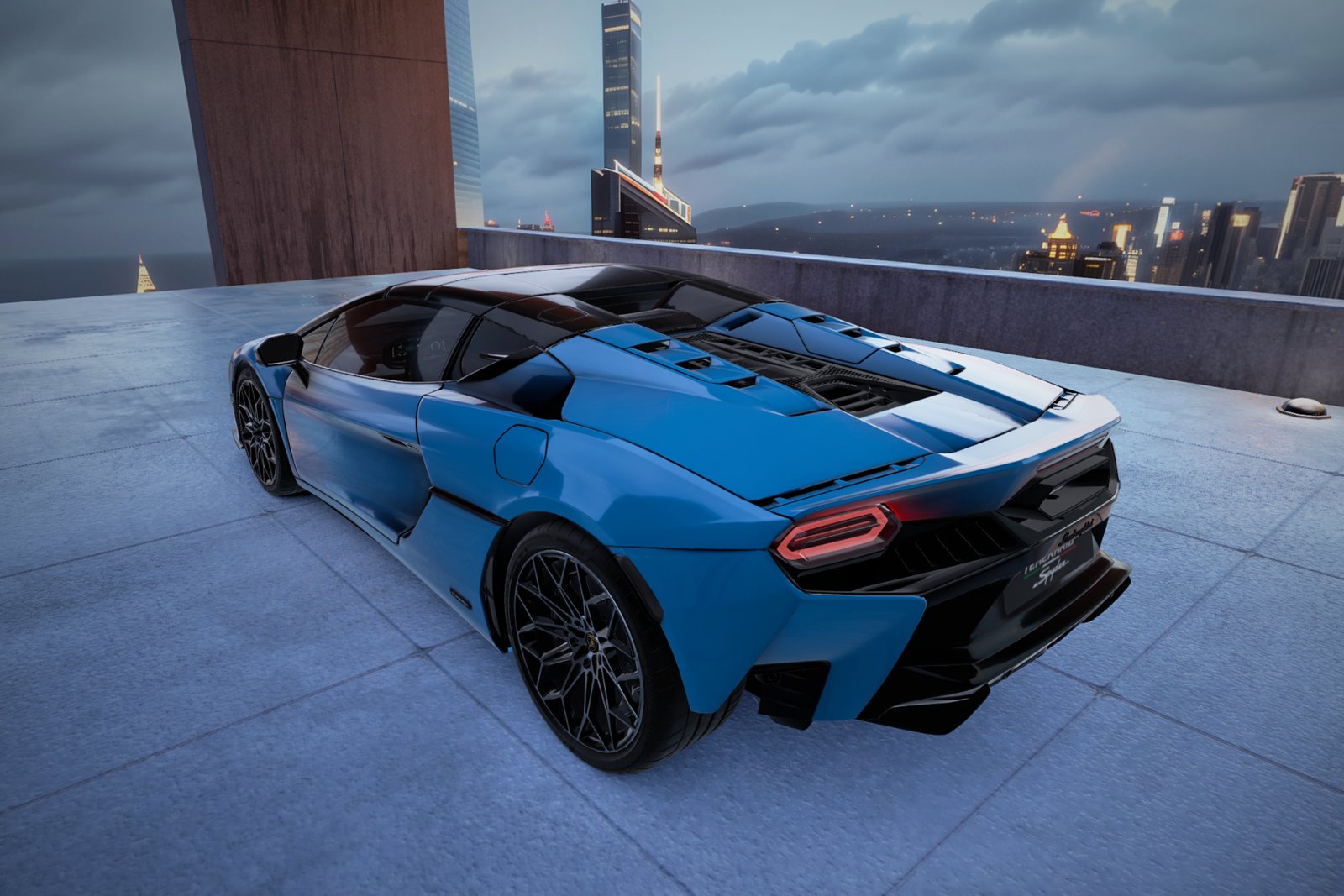
The Akrapovič titanium exhaust, photographed on the Temerario Coupé where it made its debut, and the Spyder from behind, roof up. Images: Automobili Lamborghini (exhaust photograph by Wolfango Spaccarelli; Spyder computer-generated).
The setting was chosen with the market in mind. The United States is Lamborghini’s largest worldwide, and the debut put the car in front of the Hollywood Hills. The more interesting achievement is the packaging. Most open-top cars give something back to the coupé they are based on. This one keeps the coupé’s 920 CV, and, on Lamborghini’s figures, its roof disappears without disturbing the balance of the car. Visit Lamborghini here.