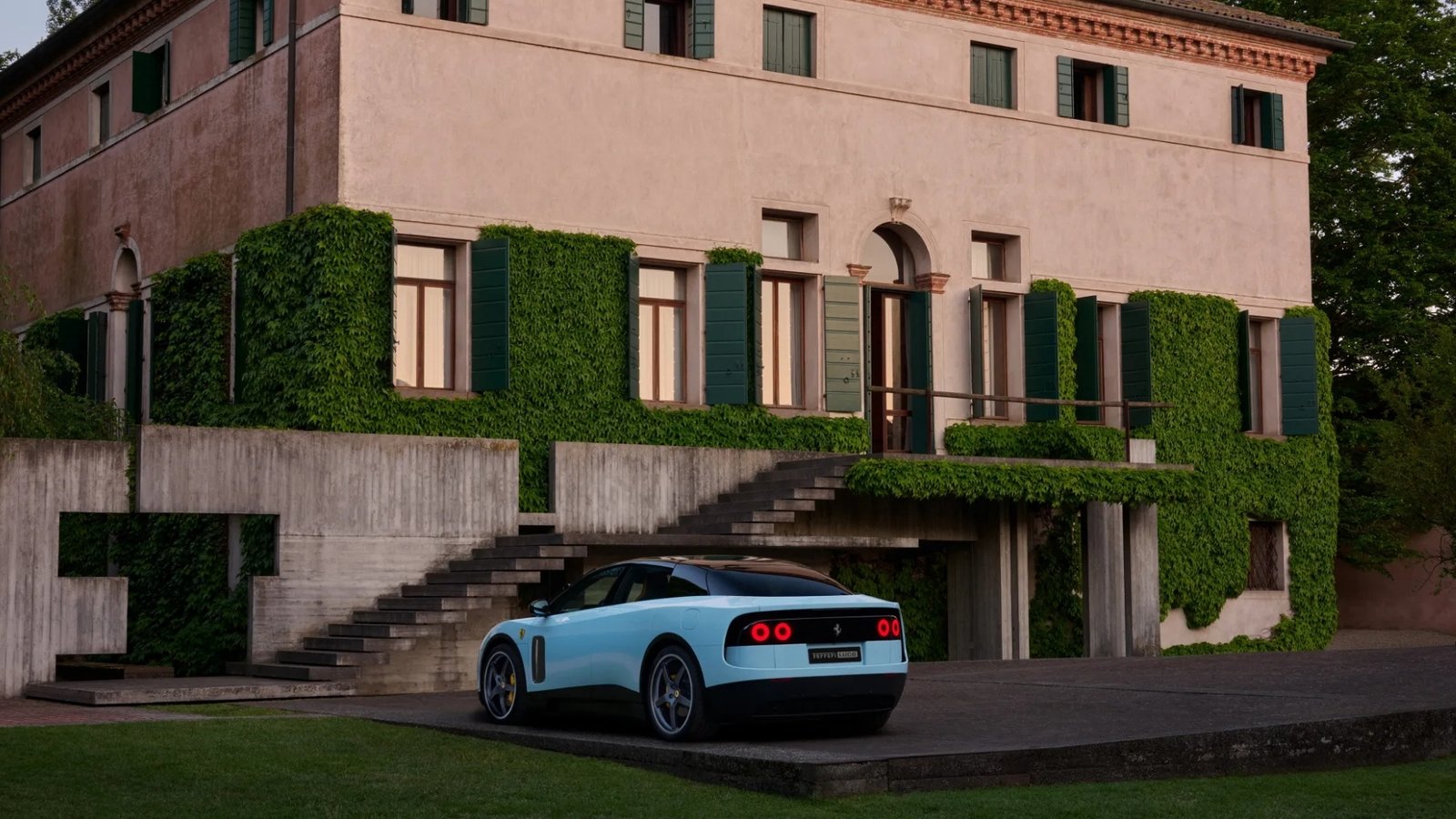


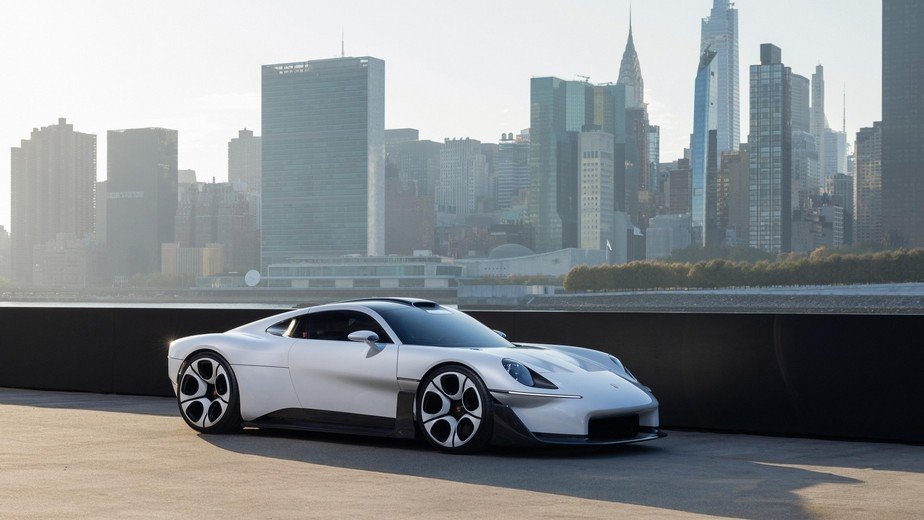


Porsche released this 1953 picture of the 550 Spyder alongside the new ones: the same Queens pier, seven decades apart. Photo: Porsche AG.
Porsche chose its pier with care. On 15 October the Mission S was shown in New York on the Queens waterfront, Manhattan behind it, at the spot that framed the 550 Spyder in 1953. The archive photograph was released alongside the new ones, in case anyone missed the rhyme. Rhymes are cheap at car launches. The sentence that matters came from Dr Michael Leiters, Porsche’s chairman, who described a mid-engined super sports car platform “positioned above the 911 — not as a one-off hypercar, but as a permanent and versatile addition to our customer offering.”
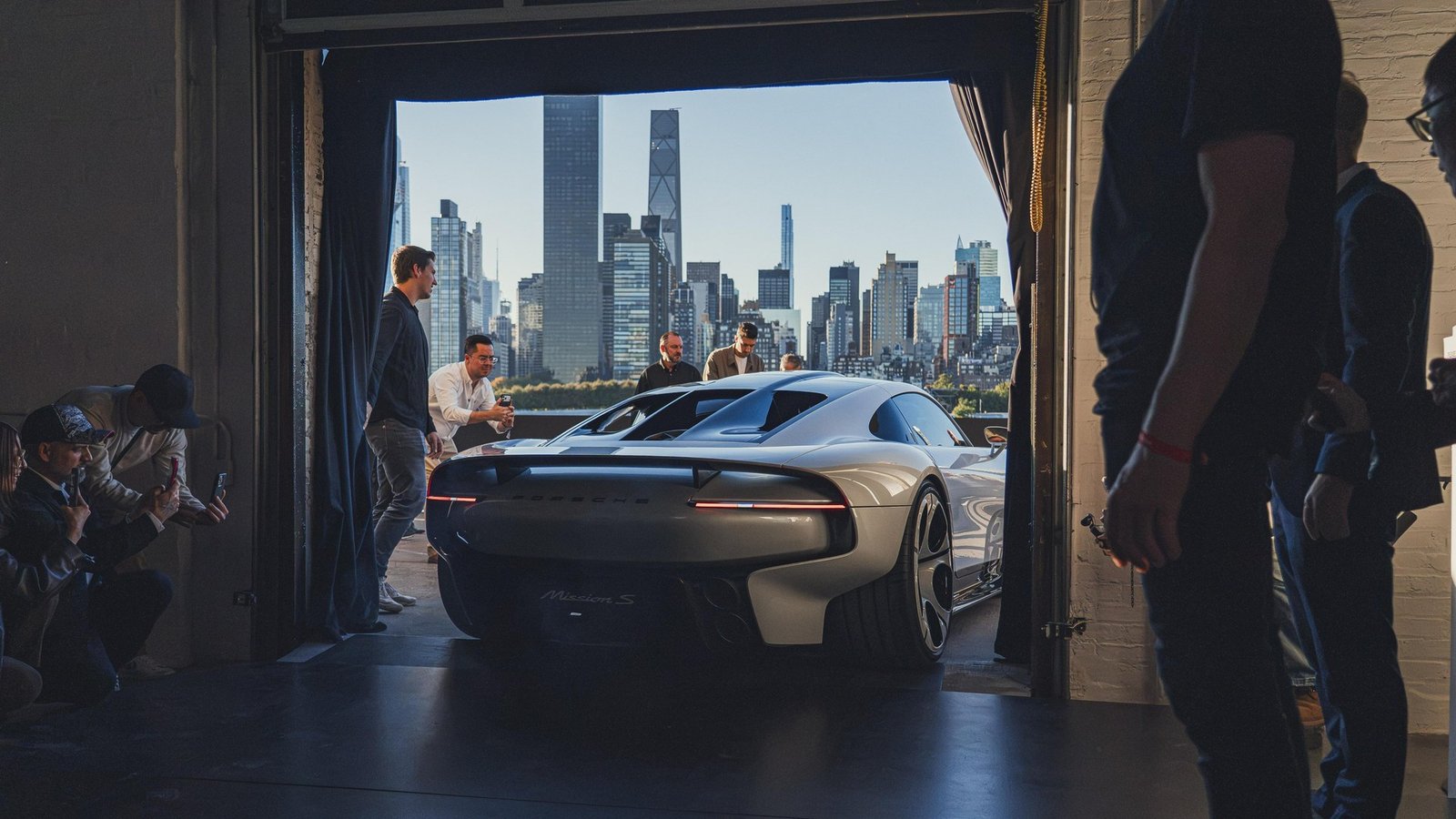
New York streets rather than a motor-show stand, presumably because that is where the car’s customers are. Photo: Porsche AG.
That is a larger statement than the car itself. For as long as most collectors can remember, the 911 has been the top of Porsche’s permanent range, with the occasional limited machine — the 959, the Carrera GT, the 918 Spyder — passing overhead and then leaving. The Mission S is presented as the first look at something that stays. The project sits within what Porsche calls Sportwagenschmiede ’35. It is labelled a vision model, and the company has said nothing about its production name, its price or when it might arrive.
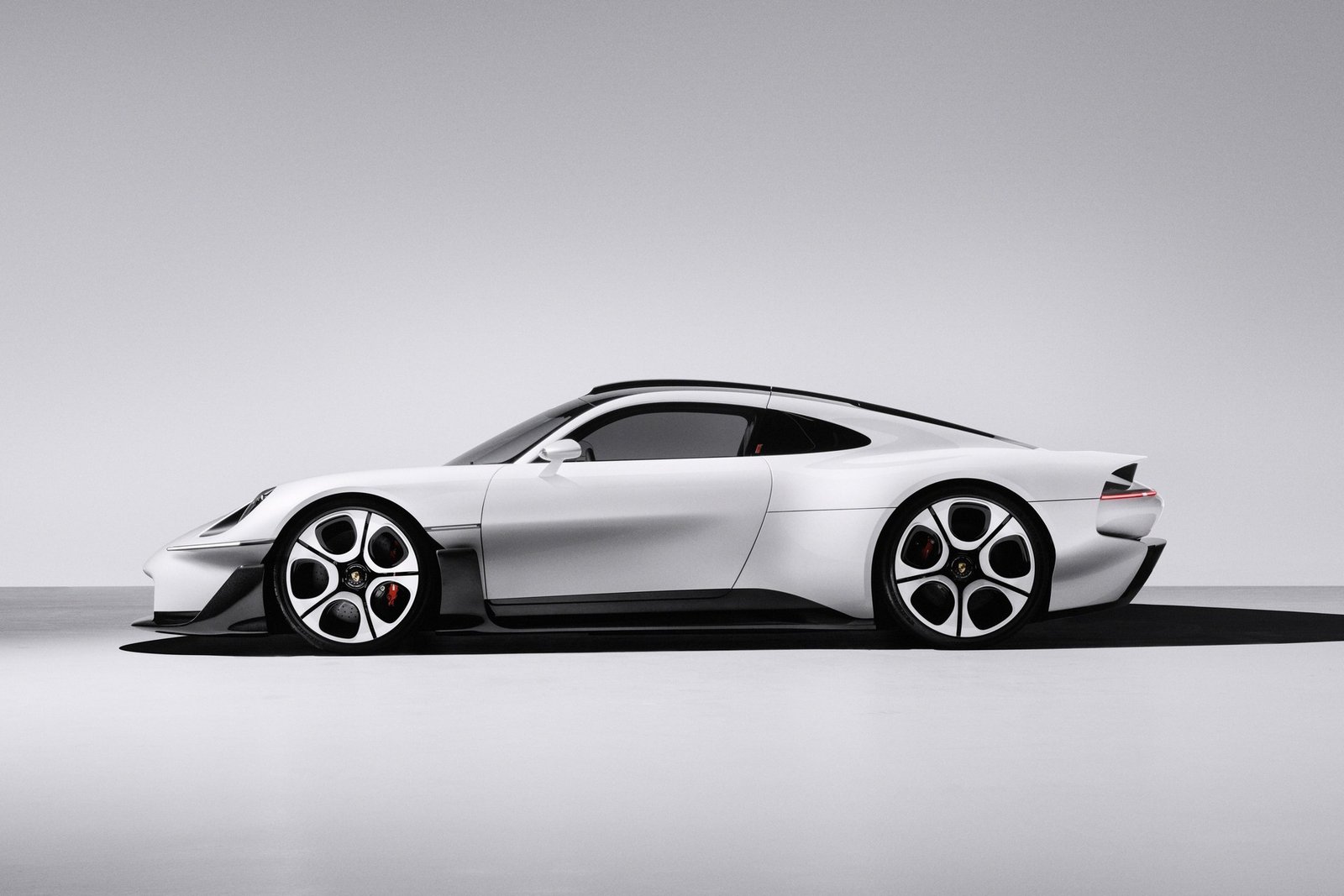
The engine sits ahead of the rear axle: a racing-car layout Porsche has only ever offered on a limited basis. Photo: Porsche AG.
The layout is the point of the exercise. In a 911 the engine hangs out behind the rear axle, a quirk Porsche has spent six decades turning into a virtue. Put the engine ahead of the rear axle, behind the driver, and you get the packaging of a racing car, which is exactly the register Porsche wants above the 911 — and exactly the one it has only ever visited on a limited basis.
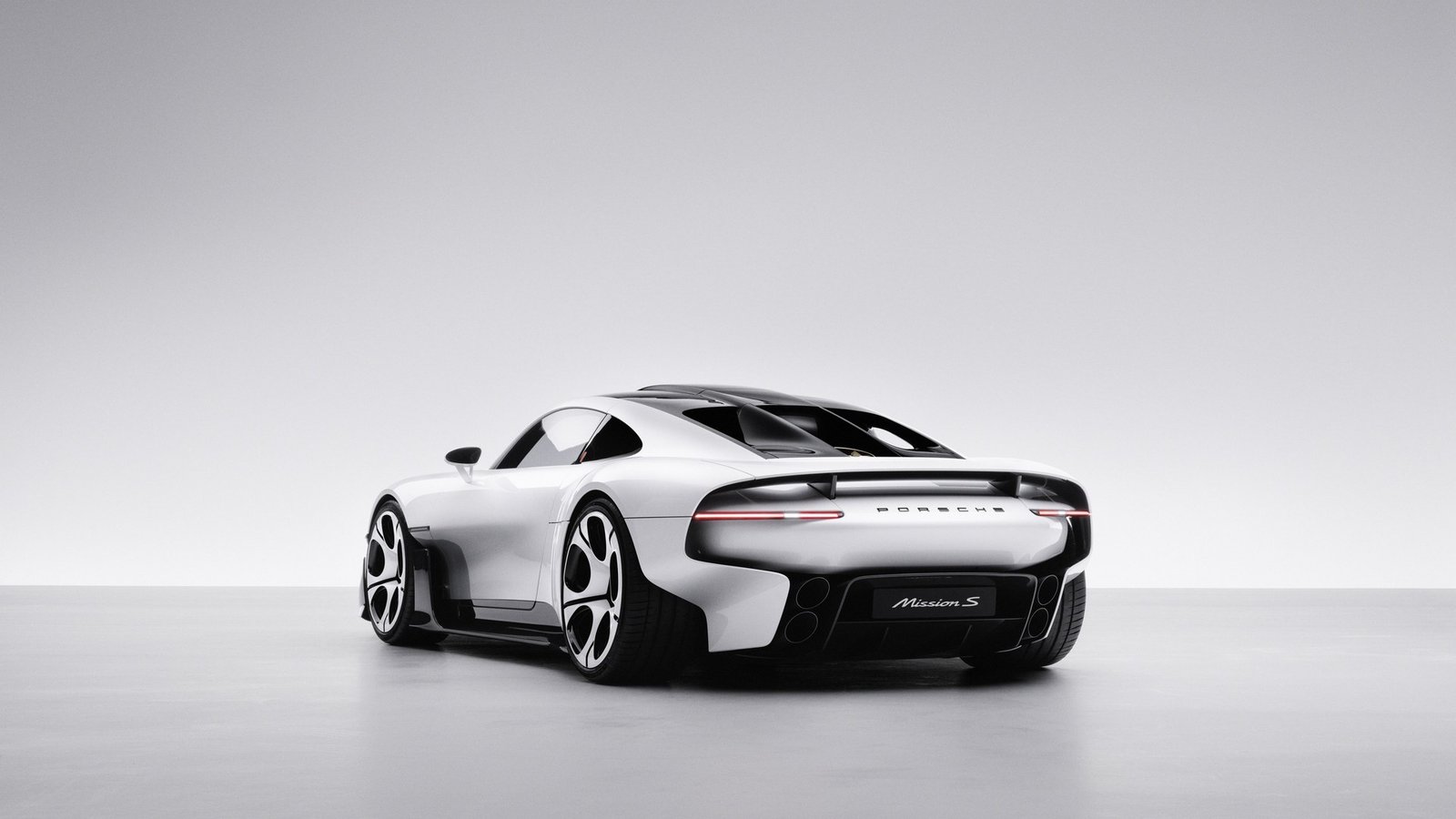
Style Porsche, under Tobias Sühlmann, treats the rear as a car within a car. Photo: Porsche AG.
Tobias Sühlmann, vice president of Style Porsche, and his team have drawn the car as a set of floating volumes, with cues taken from the 911, the GT1, the 959 and the 917. The rear is treated as a car within a car, an idea that works rather better in the metal than it does in a sentence.
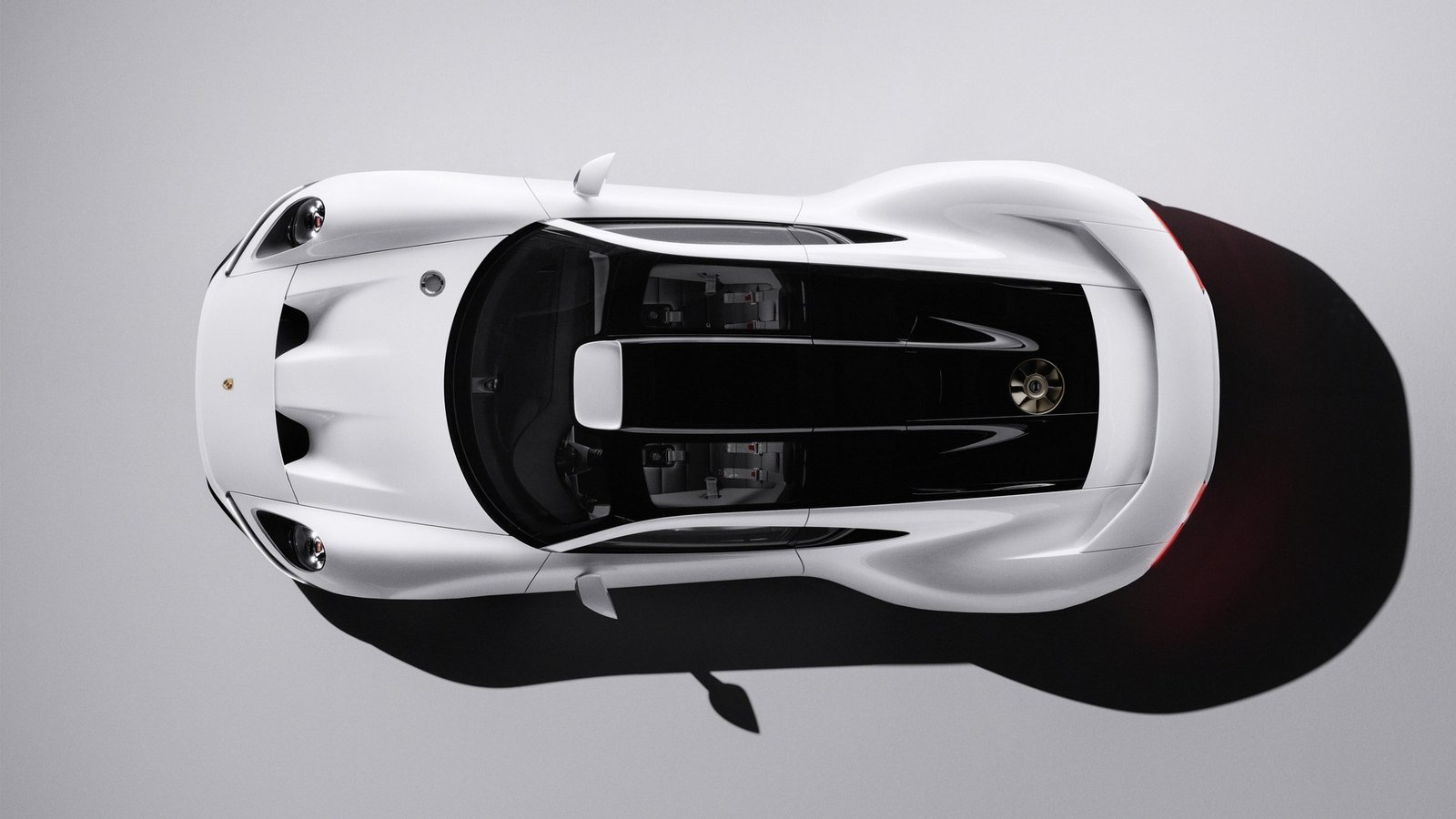
Floating volumes, with cues taken from the 911, the GT1, the 959 and the 917. Photo: Porsche AG.
The cabin is the more revealing choice. There are five round instruments behind the wheel, no permanently integrated centre display and no fixed screen for the passenger. A retractable MagSafe holder takes the driver’s own phone instead. After a decade in which car interiors have competed on the acreage of glass, Porsche has gone back to dials and handed the infotainment to the device already in your pocket.
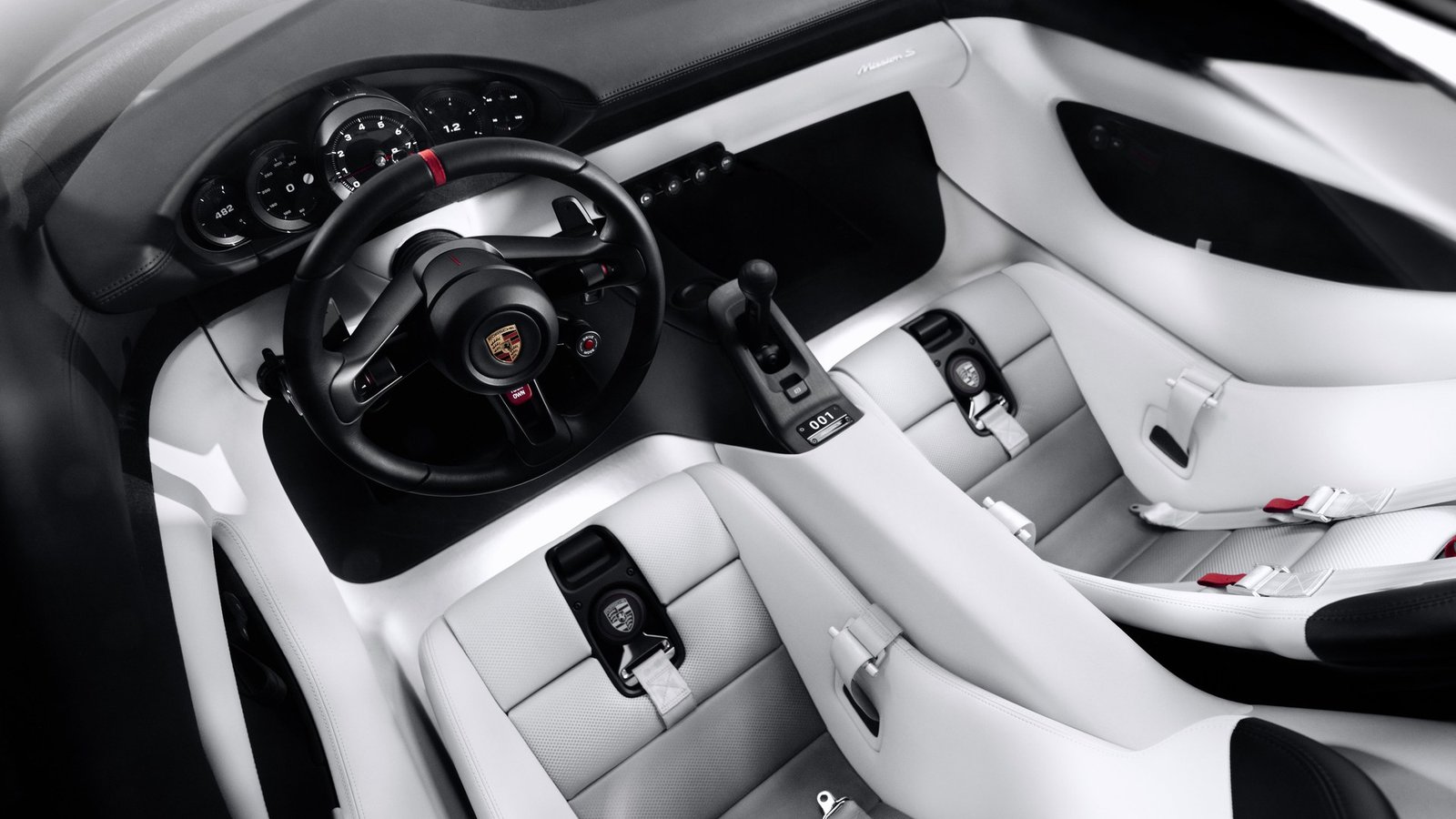

No fixed centre or passenger screen: five dials, and a retractable MagSafe holder for the driver’s own phone. Photo: Porsche AG.
What will power it is not in the release. Porsche told Car and Driver that the production line will support pure petrol engines as well as conventional and plug-in hybrids, and that there will be no fully electric version. Engine layout and output remain undisclosed; WardsAuto, reporting on 4 November, noted the same gaps. We will not guess a price on Porsche’s behalf.

Still a vision model: Porsche has given no production name, price or date. Photo: Porsche AG.
New York did the rest of the styling. The official pictures move the car from the Queens pier to a warehouse doorway facing the skyline, past the New York Public Library, and on to a cobbled Brooklyn street beneath the Manhattan Bridge. It is a long way from a motor-show stand, and the point is presumably that the car’s customers are more likely to be found in cities like this one than at the circuit.

Petrol and hybrids only; Porsche told Car and Driver there will be no fully electric version. Photo: Porsche AG.
For collectors, the change is structural. Porsche’s halo cars have been events: announced, allocated, sold out and gone. A permanent model above the 911 is a different proposition — a rung in the range to which an owner can, in principle, simply move up, without waiting for the next once-a-decade machine. It gives the brand an upper register it can maintain rather than stage. In April we noted Porsche’s renewed interest in the hypercar segment. The Mission S is a different programme and a different idea: not the next event, but a new top floor, with the stairs left in. Visit the Porsche Newsroom here.